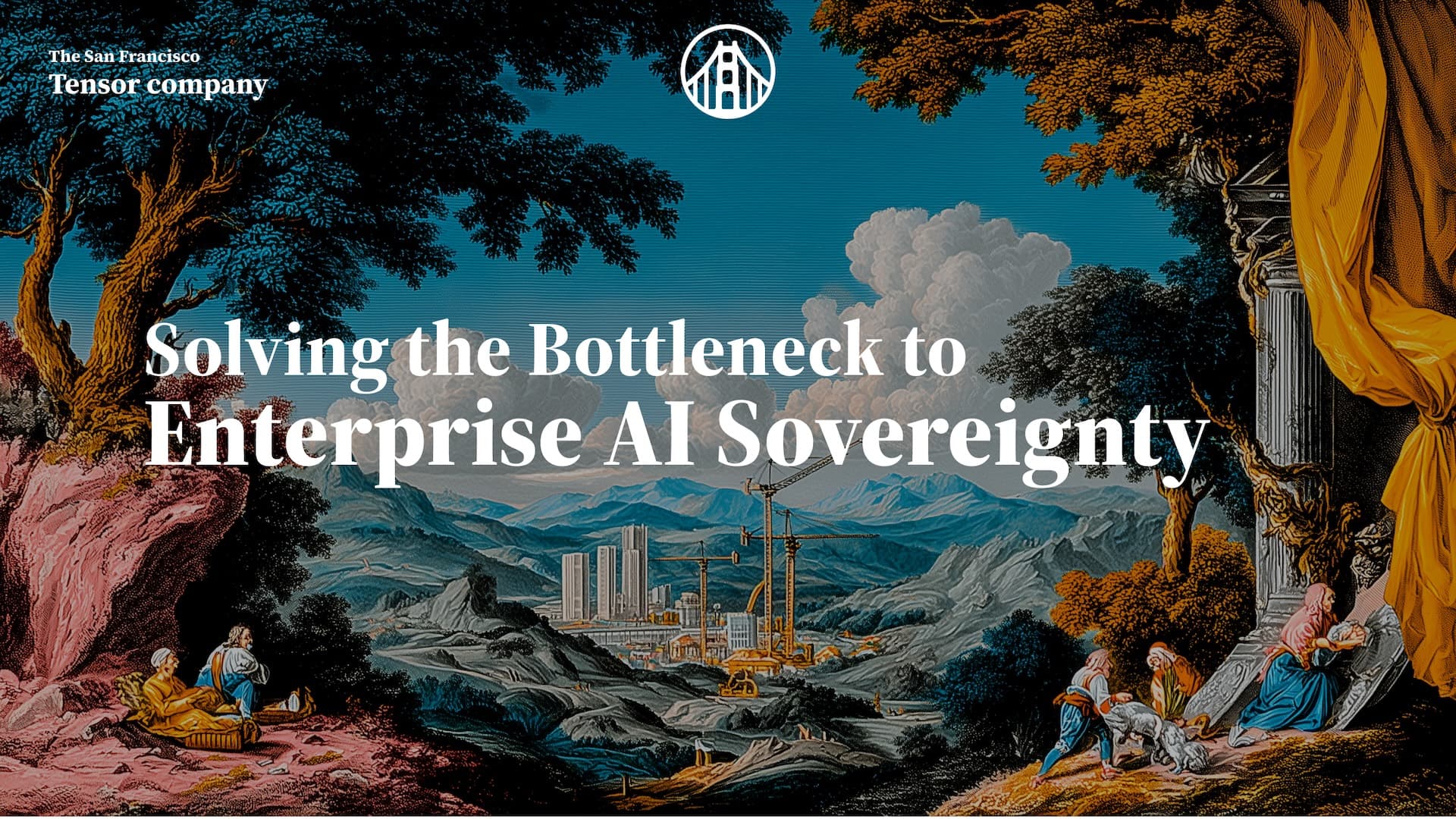
The benefits of AI are dangerously concentrated. Changing that is the single biggest untapped lever for economic growth this decade.
Our belief in the future of AI
We are still early. While progress on general-purpose text models has reached the point where people debate whether it's slowing down, the much larger story — the one that will actually move GDP – is barely underway: the diffusion of AI into every enterprise.
Right now, the value of AI is disproportionately concentrated. It accrues to the frontier labs and to the industries — chiefly software engineering — whose work happens to look most like the public internet text these models were trained on.
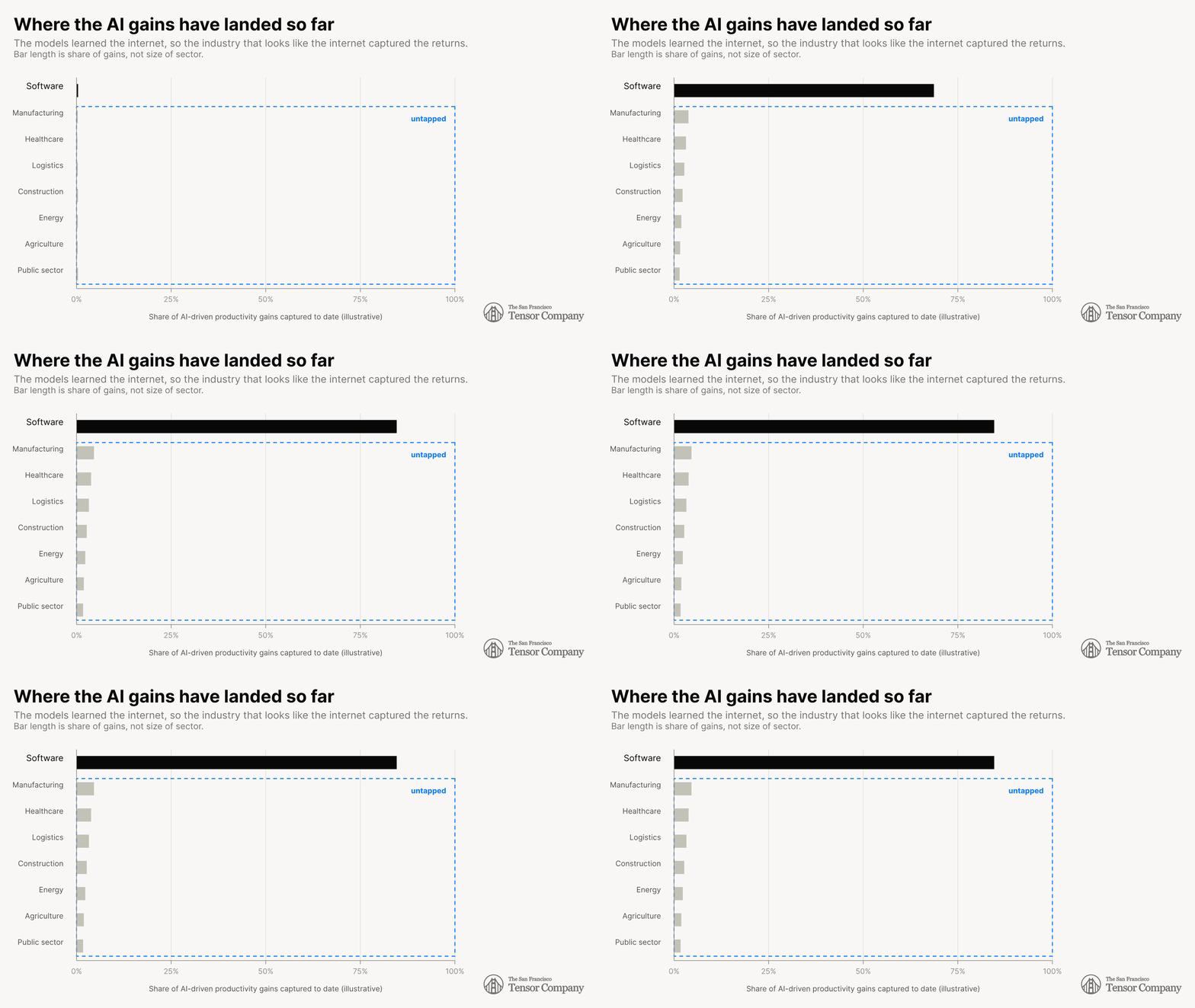
As Satya Nadella put it, “There should be as many models in the world as firms in the world.” Today, there are two core issues we see blocking AI-driven GDP growth at scale. 1. Enterprises possess valuable data but haven't captured AI-driven value, and 2. There are many new labs that can't afford to test their ideas given bottlenecks to compute.
Closing both gaps is where SF Tensor comes in.
The compute problem
The future of enterprise AI sovereignty is gated by one thing: compute and who gets to use it.
Today, two groups are effectively locked out: enterprises with the world's most proprietary data, and new labs that want to (pre-)train novel architectures but don't own hyperscaler-scale infrastructure. Both need the same thing: to train/post-train on their own data and ideas, in a cheap and predictable way. At the moment, that is neither cheap, nor available, nor self-serve.
Silicon itself isn't scarce. There are enough lithography machines to produce far more silicon than we have demand for. The problem is that everyone is chasing the same NVIDIA chip through the same constrained supply chain.
This isn't for lack of alternatives. AMD's Instinct line, Google's TPUs, AWS Trainium, Intel's Gaudi, Cerebras, Groq, and others all ship competitive hardware. Across every major chip generation since 2022, the TFLOPS per mm² improved only marginally, because the hardware did not become dramatically better, it mostly became bigger and performance between vendors is converging.
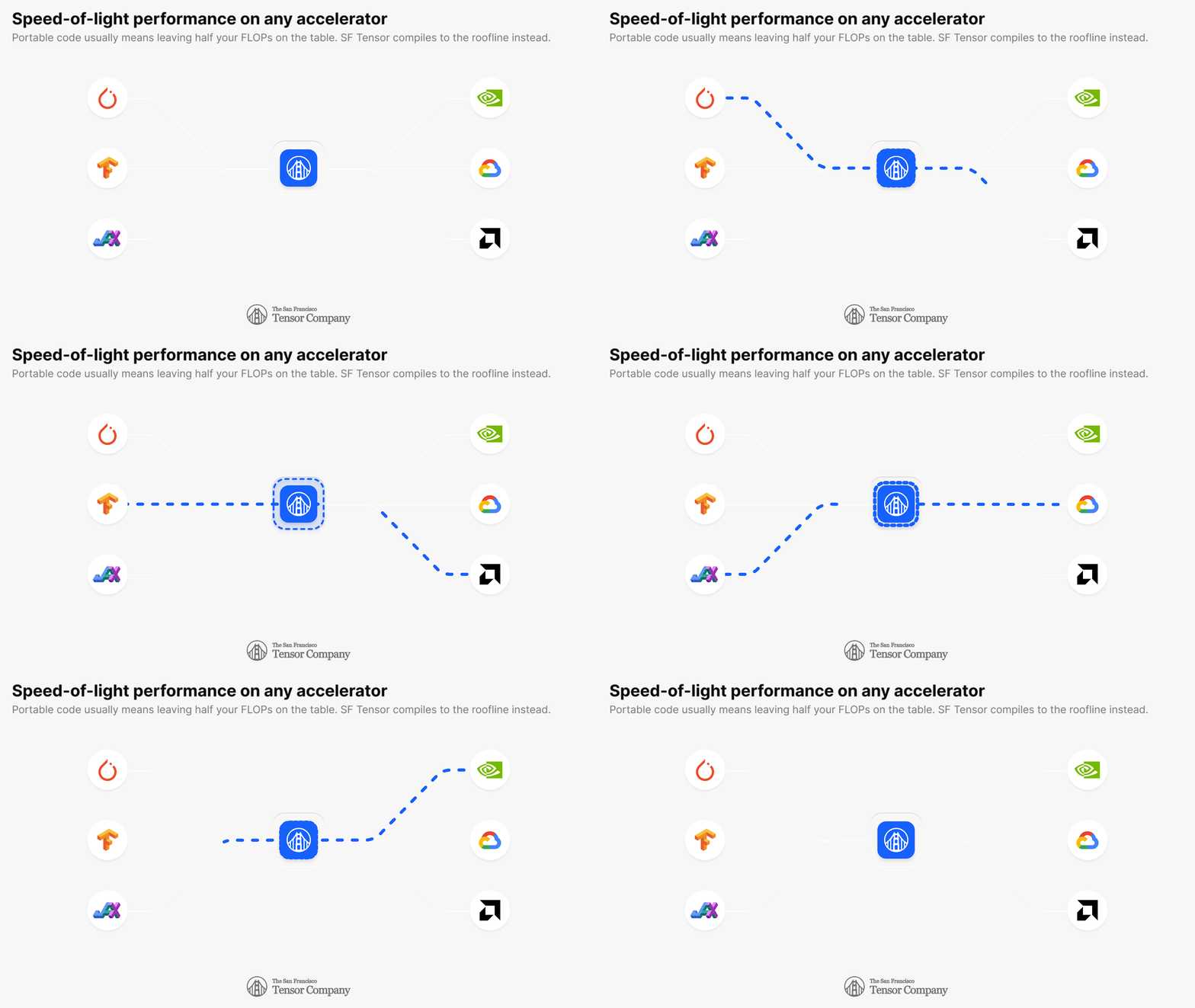
NVIDIA's monopoly is primarily one of software support, not superior hardware, and what sustains it is lock-in. Moving a workload to different silicon often means months of hand-tuning kernels, so everyone piles onto one queue for the B200s, creating an artificial shortage that keeps prices high and model-building out of reach.
Our solution
SF Tensor breaks that lock-in and solves the problem with two products.
Our core stack takes easy-to-write code, such as PyTorch or JAX, and compiles it to run at state-of-the-art utilization across multiple hardware vendors. It uses an automatic kernel optimization and search compiler that does what engineering teams perform manually today, but with no human in the loop.
Tensor Cloud targets multiple hardware vendors across different cloud providers, building a stable, homogeneous surface for a heterogenous pool of hardware. A researcher can scale from one GPU to sixty four simply by changing a configuration parameter, and then again when it's time to scale to ten thousand.
We built our stack to let enterprises post-train on data they can't hand to anyone else, while enabling new labs to pre-train on novel architectures from scratch — both at an average of 70% lower training costs. And because we automatically target whichever hardware is cheapest or best for a given workload, vendors will have to start competing on performance and price instead of benefiting from lock-in.
Jensen Huang argues every country must “own their own data” and refine it into its own intelligence. We think the same is true for every enterprise and lab, and we're building the substrate that makes that possible.